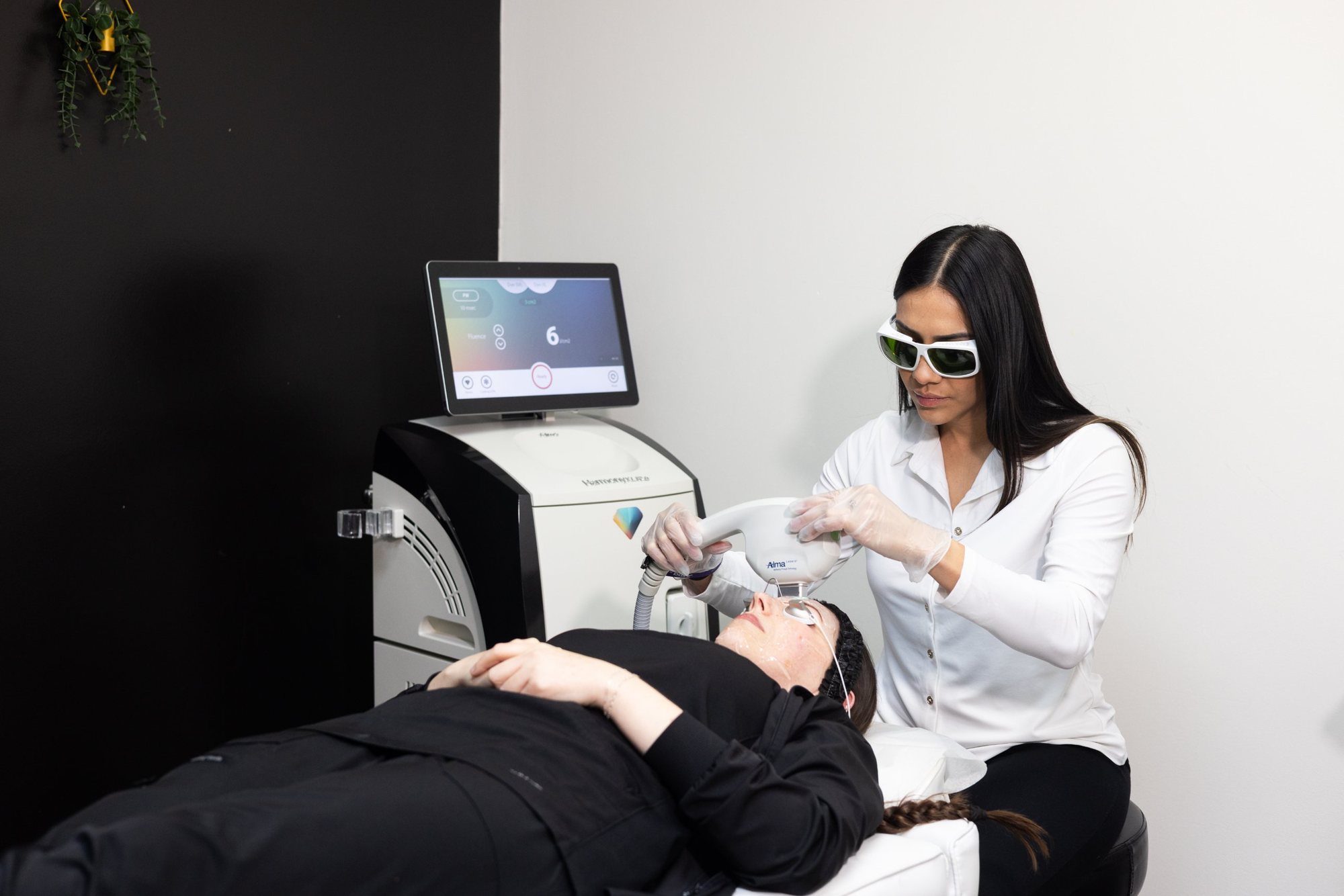
They Both Use Light, but They Are Not the Same Technology
One of the most common questions in aesthetic medicine is:
“Should I get IPL or a laser?”
It sounds like a simple question.
It is not.
IPL and lasers both use light energy to produce changes in the skin, but they deliver that energy differently.
Even more importantly, there is no single “laser treatment.”
Different lasers operate at different wavelengths, penetrate to different depths, and interact with different components of the skin.
- One laser may be designed primarily to treat pigment.
- Another may target blood vessels.
- Another may target hair follicles.
- Another may remove microscopic columns of skin to improve wrinkles and acne scars.
So asking whether IPL or laser is better is a little like asking whether a car or a truck is better.
The answer depends on what you need it to do.
Understanding the difference begins with understanding how light interacts with skin.
What Is IPL?
IPL stands for intense pulsed light.
You may also hear IPL treatments called photofacials or photorejuvenation.
Despite sometimes being grouped with laser procedures, IPL is not technically a laser.
A laser produces a more specific wavelength or narrow range of wavelengths.
IPL produces a broad spectrum of light.
Filters within the device can then restrict which portions of that light spectrum reach the skin.
This allows IPL systems to treat different chromophores and depths depending on the filter, pulse characteristics, and settings being used.
That flexibility is one reason IPL has become popular for treating patients with combinations of pigmentation and redness.
What Is a Chromophore?
To understand light based treatments, it helps to understand one important word:
Chromophore.
A chromophore is a molecule or structure that absorbs particular wavelengths of light.
Three important chromophores in aesthetic medicine are:
- Melanin, which contributes to pigmentation in the skin and hair.
- Hemoglobin, which is found in blood.
- Water, which is abundant throughout skin tissue.
Different wavelengths of light are absorbed differently by these chromophores.
That allows clinicians to select technologies based on the target.
If the goal is treating unwanted hair, melanin within the hair follicle becomes important.
If the goal is treating a visible blood vessel, hemoglobin becomes important.
If the goal is ablative skin resurfacing, water may become the primary target.
This is the foundation of modern laser and light based treatment.
The Principle of Selective Photothermolysis
Much of laser dermatology is based on a concept known as selective photothermolysis.
The basic idea is elegant.
Deliver a wavelength of light that is preferentially absorbed by a particular target.
The target absorbs the light energy.
That energy is converted into heat.
If the wavelength, pulse duration, energy, and treatment parameters are appropriately selected, the target can be damaged while minimizing unnecessary injury to surrounding tissue.
This principle helps explain why one device cannot optimally treat every problem.
Different targets require different wavelengths and treatment parameters.
IPL Uses a Range of Wavelengths
IPL devices generally emit a broad spectrum of visible and near infrared light.
Filters are used to determine which portion of that spectrum reaches the skin.
This makes IPL versatile.
Depending on the system and settings, IPL may be used to address:
- Brown spots
- Freckles
- Sun related pigmentation
- Diffuse redness
- Small superficial blood vessels
- Facial flushing associated with some vascular conditions
- Overall photodamage
- Unwanted hair
- Certain aspects of skin rejuvenation
IPL can be particularly useful when someone has multiple signs of photodamage at the same time.
For example, a patient may have scattered brown spots, diffuse redness, and uneven skin tone.
Rather than treating one tiny lesion at a time, IPL can address larger areas of mixed discoloration.
Lasers Are More Targeted
A laser differs because it produces a more specific wavelength or wavelength range.
That specificity can make lasers particularly useful when a clinician wants to target a defined chromophore, tissue depth, or type of skin problem.
Examples include:
- Alexandrite lasers around 755 nm
- Diode lasers commonly around 800 to 810 nm
- Nd:YAG lasers at 1064 nm
- Pulsed dye lasers around 585 to 595 nm
- Q switched and picosecond lasers at various wavelengths
- Erbium:YAG lasers around 2940 nm
- CO₂ lasers around 10,600 nm
These numbers may seem technical, but they matter because wavelength influences how deeply light penetrates and which chromophores absorb it.
This is why saying “I had laser” tells us surprisingly little.
The next question should be:
What kind of laser?
IPL for Brown Spots and Sun Damage
Pigmentation is one of the most common reasons patients seek IPL treatment.
Years of ultraviolet exposure can produce areas of increased pigmentation such as solar lentigines, commonly called sun spots or age spots.
IPL can deliver light that is absorbed by melanin within these pigmented areas.
The pigment may temporarily darken following treatment before gradually becoming less noticeable as the treated material is cleared.
For the right patient, this can produce a more even appearance across the face, neck, chest, hands, or other sun exposed areas.
But not every brown spot should automatically be treated with IPL.
That distinction is extremely important.
Not Every Brown Spot Is a Cosmetic Brown Spot
Pigmented lesions should be appropriately evaluated before cosmetic treatment.
A benign solar lentigo is different from a suspicious pigmented lesion.
Aesthetic devices should not be used simply to remove an undiagnosed spot because the patient does not like how it looks.
If a lesion has concerning features, has changed, is unusual, or has not been appropriately diagnosed, medical evaluation may be necessary before cosmetic treatment.
Aesthetic improvement should never interfere with appropriate skin cancer detection.
What About Melasma?
Melasma deserves special consideration.
It is a complex pigmentary disorder influenced by factors including ultraviolet exposure, visible light, hormones, genetics, and inflammation.
Aggressive light or laser treatment can sometimes worsen melasma by triggering inflammation and post inflammatory hyperpigmentation.
That does not mean energy based treatment is never used.
It means melasma should not be approached as though it were simply a collection of ordinary sun spots.
Careful diagnosis comes first.
IPL for Redness
IPL can also target hemoglobin.
This makes it useful for certain vascular concerns.
Patients may seek IPL because of:
- Diffuse facial redness
- Small superficial vessels
- Redness associated with photodamage
- Certain manifestations of rosacea
Because IPL treats relatively broad areas, it can be particularly helpful when redness is diffuse rather than confined to one isolated vessel.
Multiple treatments are often required.
Maintenance may also be necessary because vascular conditions such as rosacea are chronic and can continue producing new redness over time.
IPL can improve the appearance.
It does not eliminate the underlying tendency to develop rosacea.
When a Vascular Laser May Be Better
Sometimes the problem is not diffuse redness.
It is one specific vessel.
Or a collection of prominent vessels.
In these situations, a vascular specific laser may provide more targeted treatment.
Pulsed dye lasers, for example, use wavelengths strongly absorbed by hemoglobin and have long been used for vascular lesions.
Long pulse Nd:YAG lasers can also be useful for certain deeper or larger vessels because 1064 nm light penetrates relatively deeply.
The best choice depends on the size, depth, color, and location of the vessel as well as the patient’s skin type.
Again, there is no single “redness laser.”
IPL and Rosacea
Patients with rosacea often ask whether IPL can cure the condition.
It cannot.
Rosacea is a chronic inflammatory and vascular skin disorder.
IPL may improve visible redness, flushing, and superficial telangiectasias in selected patients.
But the underlying condition remains.
Triggers may still cause flushing.
New vessels may develop.
Maintenance treatment may be necessary.
Skincare and medical treatment may also be appropriate depending on the type of rosacea.
The goal is control and improvement, not necessarily permanent elimination.
What About Laser Hair Removal?
Hair reduction provides another excellent example of why wavelength matters.
Laser and light based hair reduction work primarily by targeting melanin within the hair follicle.
The absorbed energy is converted to heat, damaging structures involved in hair growth.
This creates an important relationship between hair color and skin color.
Dark, coarse hair contains more melanin and generally provides a stronger target.
Blond, gray, white, and many red hairs contain less of the pigment that conventional hair removal systems depend on.
That is why these hair colors can be more difficult to treat effectively.
Hair Removal Is Really Hair Reduction
The phrase “laser hair removal” is widely used, but long term hair reduction is often a more accurate description.
Hair grows in cycles.
Not every follicle is in the same phase at the same time.
Laser treatment is most effective when hairs are in an appropriate active growth phase.
This is why a series of treatments is generally required.
Even after an excellent response, some hair may eventually return.
Hormonal changes can also stimulate new growth.
Maintenance treatments may occasionally be useful.
Different Lasers for Different Skin Types
Hair removal also demonstrates why skin type matters.
The target is melanin in the hair.
But the skin also contains melanin.
If too much light energy is absorbed by epidermal melanin, the risk of burns and pigmentary changes increases.
This becomes particularly important in darker skin types.
Long pulse 1064 nm Nd:YAG lasers are frequently used for hair reduction in darker skin because the wavelength penetrates more deeply and is absorbed less strongly by epidermal melanin than some shorter wavelengths.
Alexandrite lasers may be highly effective in lighter skin types with dark hair.
Diode systems provide another option.
IPL can also reduce hair in appropriately selected patients.
The correct technology depends on the combination of skin color, hair color, hair thickness, anatomical area, and treatment parameters.
Skin Color Matters for More Than Hair Removal
Melanin influences many light based procedures.
The more epidermal melanin present, the more carefully treatment parameters may need to be selected when using wavelengths that interact strongly with pigment.
Potential complications can include:
- Post inflammatory hyperpigmentation
- Hypopigmentation
- Blistering
- Burns
- Scarring
- Prolonged discoloration
This does not mean patients with darker skin cannot receive laser or light based treatments.
It means the technology and settings must be chosen carefully.
Some wavelengths and devices have a wider safety margin in darker skin than others.
Patient selection and operator experience matter tremendously.
What Is a Q Switched Laser?
Q switched lasers deliver very short pulses of energy.
They are commonly used for certain pigmentary concerns and tattoo treatment.
Rather than relying only on prolonged heating, the short pulse produces strong photoacoustic and photothermal effects within pigmented targets.
Depending on the wavelength, Q switched lasers may target different pigment colors and depths.
The 1064 nm Nd:YAG wavelength, for example, can reach deeper pigment and is less strongly absorbed by epidermal melanin than shorter wavelengths.
A frequency doubled 532 nm wavelength targets more superficial pigment but interacts more strongly with melanin.
Again, the wavelength changes the treatment.
What Are Picosecond Lasers?
Picosecond lasers use extremely short pulses measured in trillionths of a second.
These devices were initially developed largely around tattoo and pigment treatment but have expanded into other aesthetic applications.
Very short pulse durations can produce substantial photoacoustic effects that fragment pigment particles.
Some picosecond systems also use fractional optical elements to create microscopic areas of tissue disruption for skin rejuvenation.
They can be useful tools.
But the word “picosecond” does not automatically mean a treatment is superior.
Pulse duration is only one component.
Wavelength, fluence, spot size, tissue target, device design, and patient selection still matter.
IPL Is Not a Resurfacing Laser
This distinction is particularly important.
IPL can improve the appearance of photodamaged skin by reducing brown and red discoloration.
As the skin tone becomes more even, the face may look brighter and healthier.
But IPL does not create the same type of tissue ablation and remodeling as an ablative resurfacing laser.
If the main problem is:
- Deep acne scarring
- Significant rough texture
- Etched wrinkles
- Advanced surface aging
Then IPL alone may not provide the desired correction.
A resurfacing treatment may be more appropriate.
What Is a Resurfacing Laser?
Resurfacing lasers target water within the skin.
Two important examples are:
- Erbium:YAG at approximately 2940 nm
- and CO₂ at approximately 10,600 nm
These wavelengths are strongly absorbed by water.
That allows them to remove microscopic amounts of tissue.
Fractional versions create microscopic treatment columns separated by areas of untreated or less affected tissue.
This controlled injury stimulates epidermal renewal and dermal remodeling.
These treatments can be used for:
- Wrinkles
- Rough texture
- Acne scars
- Photodamage
- Certain scars
- Overall skin rejuvenation
But resurfacing generally involves more recovery than IPL.
Ablative vs. Nonablative Lasers
Laser resurfacing can also be divided into ablative and nonablative treatments.
Ablative lasers remove portions of the epidermis and create more substantial tissue injury.
CO₂ and Erbium:YAG are classic examples.
Nonablative fractional lasers create controlled thermal injury while largely preserving the skin surface.
Nonablative treatments generally involve less downtime but may require multiple sessions to achieve the desired improvement.
This illustrates one of the most consistent principles in aesthetic medicine:
Greater treatment intensity often brings the possibility of greater improvement, but usually at the cost of greater downtime and risk.
Which Is Better for Skin Rejuvenation?
It depends on what “rejuvenation” means.
If someone says:
“My skin has brown spots and diffuse redness from years of sun exposure.”
IPL may be an excellent choice.
If someone says:
“My biggest concern is acne scarring and rough texture.”
A fractional resurfacing laser or RF microneedling may be more appropriate.
If someone says:
“I have deep wrinkles around my mouth.”
An ablative resurfacing approach may deserve consideration.
If someone says:
“I have one prominent facial blood vessel.”
A vascular specific laser may make more sense.
If someone says:
“I want permanent removal of gray hair.”
Neither IPL nor conventional laser hair reduction is likely to provide the result they imagine because there is insufficient melanin to target effectively.
The diagnosis drives the technology.
Why One Device Cannot Do Everything
Aesthetic devices are sometimes marketed as though one platform can solve every skin problem.
That should make patients cautious.
Pigment, blood vessels, hair follicles, wrinkles, acne scars, and skin laxity are fundamentally different targets.
Some multifunction platforms contain several different technologies.
That can be very useful.
But each handpiece or wavelength still works through its own biological mechanism.
The best aesthetic practices do not begin with:
“What can we treat with this machine?”
They begin with:
“What does this patient’s skin actually need?”
Then the appropriate technology is selected.
Why a Evaluation Matters
A proper light or laser evaluation should evaluate more than the area the patient wants treated.
The clinician may consider:
- Skin type
- Degree of pigmentation
- Recent sun exposure
- History of tanning
- Medical conditions
- Medications
- Previous laser treatments
- History of abnormal scarring
- History of post inflammatory hyperpigmentation
- Presence of active infection or inflammation
- Pregnancy
History of cold sores when relevant
Specific diagnosis of the lesion
Treatment goals
Tolerance for downtime
These factors can influence both safety and outcome.
Why Recent Tanning Is a Problem
A tan represents increased melanin in the skin.
When treating with light that can be absorbed by melanin, recently tanned skin may absorb more energy than intended.
This can increase the risk of burns and pigmentary complications.
Patients should disclose recent sun exposure and tanning.
Trying to hide a tan in order to proceed with treatment is not worth the risk.
Aesthetic treatment can wait.
Skin injury can last much longer.
What Does IPL Feel Like?
IPL is often described as producing brief snapping or stinging sensations as pulses of light are delivered.
Cooling systems or cooling gel may be used depending on the device.
Immediately afterward, the skin may appear mildly red.
Pigmented lesions can temporarily darken.
Small areas of swelling may develop.
Recovery is generally shorter than with ablative resurfacing, although treatment intensity and individual response vary.
What Does Laser Treatment Feel Like?
That depends entirely on the laser.
A gentle nonablative treatment may produce warmth and mild redness.
A vascular laser may feel like brief snapping sensations.
Laser hair reduction may feel like repeated heat or pinpricks.
Fractional nonablative resurfacing may require topical anesthetic.
Fractional CO₂ resurfacing can involve substantially more discomfort and recovery.
There is no universal “laser experience.”
That is another reason patients should know exactly which technology is being proposed.
How Many Treatments Will You Need?
Again, it depends.
IPL photorejuvenation commonly involves a series of treatments.
Hair reduction requires multiple sessions because of the hair growth cycle.
Vascular lesions may require one or several treatments.
Pigmentation may improve after one treatment but often benefits from a series.
Nonablative rejuvenation generally requires multiple sessions.
More aggressive ablative resurfacing may produce substantial improvement from fewer treatments but involves greater recovery.
A treatment plan should be based on response rather than assuming everyone needs the same package.
Is IPL Better Because It Treats More Than One Color?
Not necessarily.
The broad spectrum of IPL is an advantage when treating mixed pigmentation and vascular concerns across a larger area.
But the specificity of a laser can be an advantage when treating a defined target.
Versatility and precision are different strengths.
Neither automatically wins.
Is Laser Stronger Than IPL?
Sometimes.
But “stronger” is not a useful medical endpoint.
A CO₂ laser can create dramatically more tissue injury than a typical IPL treatment.
A gentle nonablative laser may create far less visible reaction.
A vascular laser may be extremely selective rather than simply aggressive.
What matters is not how powerful the machine sounds.
What matters is whether the delivered energy produces the correct tissue effect for the problem being treated.
More Energy Is Not Better
Light and laser procedures depend on carefully selected parameters.
Increasing energy indiscriminately does not guarantee a better result.
It can simply increase the risk of:
- Burns
- Blistering
- Pigment changes
- Prolonged redness
- Scarring
- Unwanted tissue injury
Effective treatment is not about using the highest possible setting.
It is about using the appropriate wavelength, fluence, pulse duration, spot size, cooling, and treatment pattern for the target and patient.
Precision is more important than aggression.
IPL vs. Laser: A Simple Way to Think About It
Think of IPL as a versatile broad spectrum light treatment.
It can be particularly useful when several superficial color related concerns exist across a larger area, such as brown spots combined with redness.
Think of a laser as a more wavelength specific tool.
Depending on the laser, it can be selected to target pigment, blood vessels, hair follicles, water, deeper tissue, or specific structural problems.
Neither is inherently superior.
The question is not:
“IPL or laser?”
The better question is:
“What exactly are we trying to treat?”
Treat the Diagnosis, Not the Device
At Vita Nova AntiAging and Rejuvenation Center, we believe light and laser treatment should begin with identifying the actual concern.
If the problem is sun related pigmentation and diffuse redness, IPL may be an excellent option.
If the concern is a specific vascular lesion, a vascular laser may provide greater precision.
If the goal is hair reduction, wavelength and skin type become particularly important.
If acne scars and texture are the primary concern, fractional resurfacing or another remodeling treatment may be more appropriate.
If significant wrinkles and photodamage are present, ablative fractional resurfacing may deserve consideration.
And sometimes a combination of technologies provides the most appropriate plan.
Modern aesthetic medicine offers more light and energy based technologies than ever before.
That is an advantage only when those technologies are used thoughtfully.
The name on the machine matters less than the diagnosis.
The wavelength matters.
The target matters.
The settings matter.
The patient’s skin matters.
And the person operating the technology matters.
The best treatment is not necessarily the newest laser, the strongest device, or the procedure currently trending online.
It is the technology that most appropriately matches the patient’s skin, concern, goals, and tolerance for recovery.
Related Reading
- CO₂ Laser Resurfacing: What It Can—and Cannot—Do for Aging Skin
- Aesthetic Medicine in 2026: Why Natural Looking Results Are the New Standard
Learn more about IPL photofacial treatments at Vita Nova AntiAging and Rejuvenation Center.
References
- Anderson RR, Parrish JA. Selective Photothermolysis: Precise Microsurgery by Selective Absorption of Pulsed Radiation. Science. 1983;220:524 to 527.
- Wat H, Wu DC, Rao J, Goldman MP. Application of Intense Pulsed Light in the Treatment of Dermatologic Disease: A Systematic Review. Dermatologic Surgery. 2014;40:359 to 377.
- Babilas P, Schreml S, Szeimies RM, Landthaler M. Intense Pulsed Light Sources. Journal of the German Society of Dermatology. 2010;8:467 to 476.
- Ash C, Town G, Whittall R, Tooze L, Phillips J. Lasers and Intense Pulsed Light Sources for the Treatment of Pigmentary and Vascular Disorders. Lasers in Medical Science. 2017.
- Haedersdal M, Wulf HC. Evidence Based Review of Hair Removal Using Lasers and Light Sources. Journal of the European Academy of Dermatology and Venereology. 2006;20:9 to 20.
- Gan SD, Graber EM. Laser Hair Removal: A Review. Dermatologic Surgery. 2013;39:823 to 838.
- Alexiades M, et al. Review of Lasers and Energy Based Devices for Skin Rejuvenation and Scar Treatment With Histologic Correlations. Dermatologic Surgery. 2022.
- Manstein D, Herron GS, Sink RK, Tanner H, Anderson RR. Fractional Photothermolysis: A New Concept for Cutaneous Remodeling Using Microscopic Patterns of Thermal Injury. Lasers in Surgery and Medicine. 2004;34:426 to 438.
- Omi T, Numano K. The Role of the CO₂ Laser and Fractional CO₂ Laser in Dermatology. Laser Therapy. 2014;23:49 to 60.
- American Society for Dermatologic Surgery. Laser and Light Therapy: Patient Safety and Treatment Considerations.
Medical Disclaimer
This article is intended for general educational purposes and should not be considered individualized medical advice or a recommendation for IPL, laser therapy, or any other aesthetic procedure. Light and laser treatments can cause adverse effects including pain, redness, swelling, burns, blistering, post inflammatory hyperpigmentation, hypopigmentation, infection, scarring, and other complications. Pigmented lesions should be appropriately evaluated before cosmetic treatment. Device selection, wavelength, treatment settings, preparation, treatment intervals, and aftercare should be individualized by an appropriately trained and licensed healthcare professional after considering skin type, medical history, medications, previous procedures, recent sun exposure, pigmentation risk, and individual treatment goals.