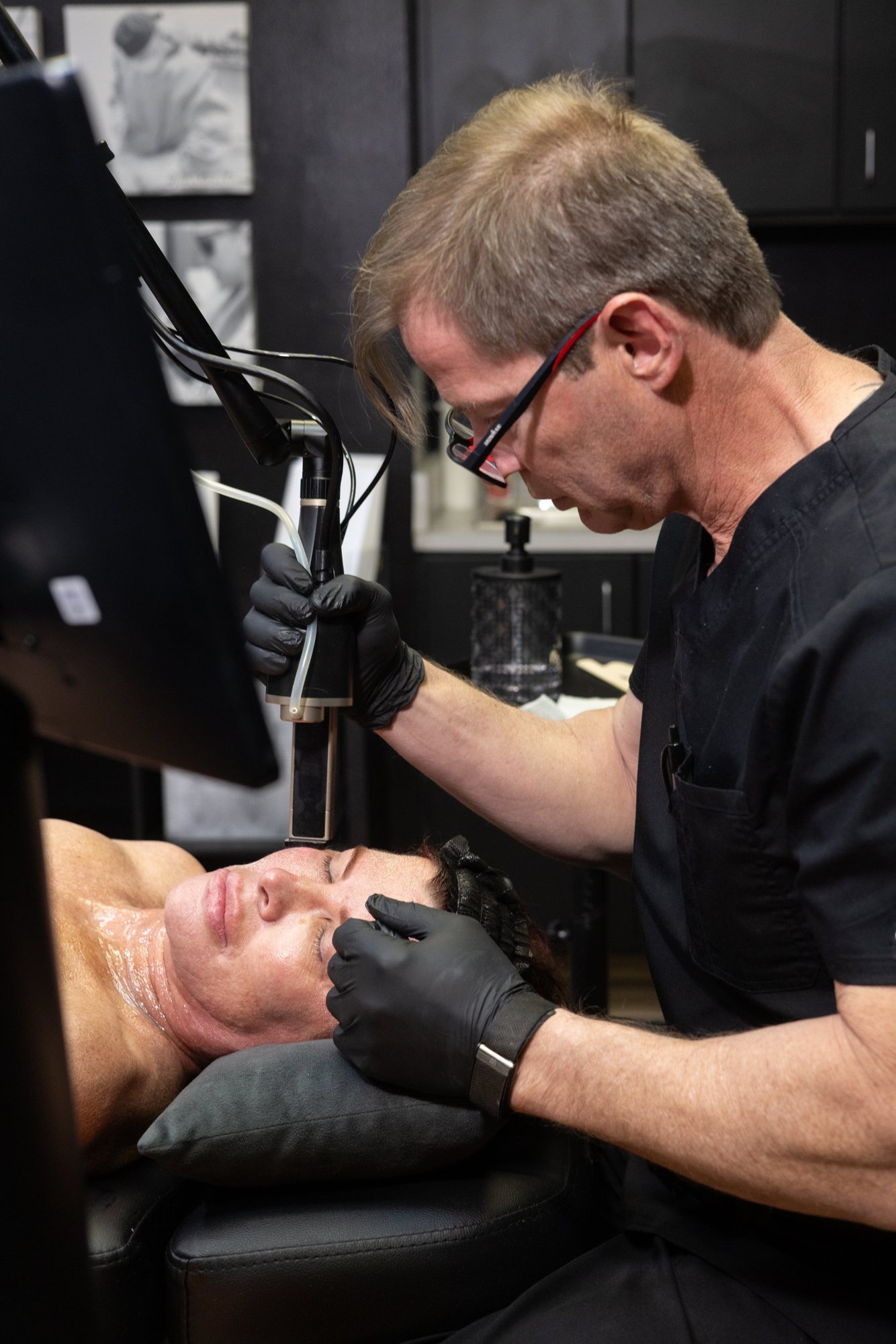
One of the Most Powerful Tools in Skin Resurfacing
Some aesthetic treatments are designed to produce subtle improvement with very little interruption to daily life.
CO₂ laser resurfacing belongs to a different category.
It can be one of the more powerful tools available for improving visible signs of skin aging, including wrinkles, rough texture, photodamage, and selected acne scars.
But that effectiveness comes with tradeoffs.
CO₂ resurfacing generally produces more inflammation, more recovery, and greater potential for complications than many gentler aesthetic treatments.
That is why the conversation should never begin with:
“How aggressive can we make the treatment?”
It should begin with:
“What are we trying to improve, and is CO₂ resurfacing the appropriate tool for this patient?”
When selected and performed appropriately, fractional CO₂ resurfacing can produce meaningful improvement in skin quality.
But it cannot correct every component of facial aging.
Understanding that distinction is essential.
What Is a CO₂ Laser?
CO₂ stands for carbon dioxide.
A CO₂ laser produces light at a wavelength of approximately 10,600 nanometers.
Water strongly absorbs energy at this wavelength.
Because human skin contains a significant amount of water, CO₂ laser energy can precisely heat and vaporize microscopic amounts of tissue.
This creates an ablative effect.
That is one of the major differences between CO₂ lasers and many nonablative laser technologies.
Ablative resurfacing removes or vaporizes portions of tissue while simultaneously producing thermal effects in surrounding tissue.
This controlled injury initiates a wound healing response that can result in epidermal renewal and dermal remodeling.
That is why CO₂ resurfacing can produce significant changes in skin texture and wrinkles.
It is not simply warming the skin.
It is intentionally creating a controlled injury and asking the skin to repair itself.
Traditional CO₂ Resurfacing vs. Fractional CO₂
Older fully ablative CO₂ resurfacing techniques treated essentially the entire surface of the targeted skin.
These procedures could produce impressive results, but recovery could be substantial and the risk of complications was greater.
Fractional technology changed the approach.
Instead of uniformly ablating the entire treatment area, fractional CO₂ lasers create microscopic columns of treatment separated by areas of relatively untreated skin.
These microscopic treatment zones extend through the epidermis and into varying depths of the dermis depending on the device and settings.
The surrounding untreated tissue can assist with healing.
This allows clinicians to create meaningful resurfacing and remodeling while generally reducing recovery compared with traditional full field ablative resurfacing.
But “fractional” does not mean mild.
Fractional CO₂ can still be an aggressive procedure.
Treatment intensity can vary dramatically.
Why Does CO₂ Resurfacing Improve Aging Skin?
Aging skin changes at multiple levels.
The epidermis changes.
Collagen becomes fragmented and disorganized.
Elastic fibers change.
Sun exposure produces cumulative cellular and structural damage.
Pigmentation becomes less even.
Texture becomes rougher.
Fine lines become deeper.
CO₂ resurfacing addresses several of these problems simultaneously.
The ablative component removes microscopic columns of damaged tissue.
The thermal component produces controlled heating in the surrounding dermis.
The body then begins repairing that injury.
Fibroblasts participate in wound healing.
New collagen can be produced.
Existing collagen undergoes remodeling.
The epidermis regenerates.
These processes continue after the visible surface has healed.
That means the final result is not created entirely on treatment day.
Part of the improvement develops over the following weeks and months as remodeling continues.
What Can CO₂ Laser Resurfacing Improve?
CO₂ resurfacing is particularly useful when the primary problem involves the surface and structural quality of the skin.
Depending on the patient and treatment settings, it may improve:
- Fine lines and wrinkles
- Rough or uneven texture
- Photodamage
- Selected pigmentation abnormalities related to sun damage
- Acne scarring
- Certain traumatic or surgical scars
- Enlarged appearing pores
- Overall skin quality
- Some degree of superficial skin tightening
The key phrase is may improve.
Laser resurfacing does not erase every abnormality.
The degree of improvement depends on the severity and type of problem, treatment intensity, number of treatments, skin type, healing response, and individual biology.
CO₂ Laser Resurfacing and Wrinkles
Wrinkles are among the most common reasons patients consider CO₂ resurfacing.
The treatment can be particularly useful for fine and moderately etched lines associated with photodamage and changes in skin structure.
Areas around the mouth can sometimes respond well because these vertical lines frequently have a significant dermal and surface component.
Fine lines around the eyes may also improve.
But not every wrinkle has the same cause.
Some wrinkles are primarily dynamic.
They occur because underlying muscles repeatedly contract.
Forehead lines, glabellar lines between the eyebrows, and crow’s feet often have a strong dynamic component.
A CO₂ laser can improve the quality of the overlying skin, but it does not stop the underlying muscle from contracting.
That is why neuromodulators may be more appropriate for certain dynamic wrinkles.
Sometimes the best approach involves more than one treatment modality.
What About Deep Wrinkles?
Deep wrinkles may improve, but patients should not expect them necessarily to disappear.
A wrinkle that has developed over decades reflects more than surface damage.
There may be changes in collagen, elastin, fat, muscle activity, facial volume, bone structure, and tissue position.
Laser resurfacing addresses some of those components.
It does not address all of them.
The goal should be softer lines and improved skin quality rather than perfectly smooth skin.
Realistic expectations matter.
CO₂ Laser and Sun Damage
Sun exposure is one of the most important external drivers of skin aging.
Ultraviolet radiation contributes to collagen breakdown, abnormal elastin, pigmentation changes, rough texture, and wrinkles.
Over years, this produces the characteristic changes known as photoaging.
CO₂ resurfacing can improve several visible manifestations of photodamage simultaneously.
Texture can become smoother.
Some areas of uneven pigmentation may improve.
Fine lines can soften.
Skin may appear more uniform and rejuvenated as the epidermis heals and the dermis remodels.
This is one reason resurfacing can sometimes create a more noticeable improvement than treating individual wrinkles one at a time.
It addresses the skin as a larger unit.
But there is an important catch.
A laser cannot protect the skin from future ultraviolet damage.
If someone undergoes resurfacing and then returns to substantial unprotected sun exposure, new photodamage will continue accumulating.
Sun protection is not optional after laser resurfacing.
It becomes part of maintaining the result.
Texture Is Where Resurfacing Can Shine
Sometimes patients say:
“I don’t have one specific problem. My skin just doesn’t look as smooth anymore.”
That is an important aesthetic concern.
Healthy looking skin reflects light relatively evenly.
As texture becomes rough or irregular, the skin can appear older even without dramatic wrinkles.
Fractional CO₂ resurfacing can improve texture by creating widespread microscopic treatment zones and stimulating tissue renewal.
This can be helpful for:
- Rough skin
- Fine creasing
- Uneven surface texture
- Certain enlarged appearing pores
- Acne related textural changes
- Photodamaged skin
Rather than simply adding volume beneath the skin, resurfacing works on the skin itself.
That distinction is important.
CO₂ Laser Resurfacing and Acne Scars
Acne scars are another major indication for fractional CO₂ treatment.
But acne scars are not all the same.
Atrophic acne scars are commonly divided into several patterns.
Rolling scars create broad depressions and may be associated with fibrous tethering beneath the skin.
Boxcar scars are depressed scars with more clearly defined edges.
Ice pick scars are narrow but can extend deeply into the skin.
Fractional CO₂ resurfacing can improve many atrophic acne scars by stimulating remodeling and improving the transition between scarred and surrounding skin.
Research comparing fractional CO₂ resurfacing with other acne scar treatments generally supports its effectiveness.
But the scar type matters.
Deep ice pick scars may respond poorly to resurfacing alone.
Tethered rolling scars may require subcision.
Some sharply defined scars may benefit from other targeted techniques.
The best acne scar plan may therefore involve several treatments rather than attempting to force one device to solve every scar.
Acne Scars Are Usually Improved, Not Erased
This deserves emphasis.
Acne scars represent structural changes within the skin.
A laser cannot restore every scarred area to skin that has never been injured.
The objective is to make scars less noticeable.
Edges may soften.
Depressions may become shallower.
Texture may become more uniform.
Light may reflect more evenly across the skin.
That can produce meaningful cosmetic improvement.
But promising “scar removal” creates unrealistic expectations.
A better term is scar remodeling.
Can CO₂ Laser Tighten Skin?
Yes, to a degree.
The thermal effects associated with CO₂ resurfacing can produce collagen contraction and subsequent remodeling.
This can improve the appearance of mild skin laxity.
But CO₂ resurfacing is not a facelift.
This distinction is critical.
If the primary problem is skin quality with mild laxity, resurfacing may be very useful.
If the primary problem is substantial jowling, significant neck laxity, major tissue descent, or large amounts of excess skin, laser resurfacing cannot physically reposition those tissues the way surgery can.
Trying to correct structural facial descent by repeatedly resurfacing the skin is unlikely to produce a surgical result.
Use the right tool for the right problem.
What CO₂ Laser Cannot Do
Understanding the limitations of treatment is just as important as understanding the benefits.
CO₂ resurfacing cannot reliably:
- Replace a surgical facelift
- Replace a neck lift when significant excess skin is present
- Restore major facial volume loss
- Stop facial muscles from creating dynamic wrinkles
- Erase every acne scar
- Prevent future aging
- Prevent future sun damage
- Permanently eliminate all pigmentation
- Create perfectly smooth, poreless skin
- Change underlying facial bone structure
- Correct every cause of facial aging
That does not make the treatment less valuable.
It makes patient selection more intelligent.
A powerful treatment becomes even more useful when it is used for the problem it was designed to address.
Why Treatment Settings Matter So Much
Not every fractional CO₂ treatment is the same.
This is one of the most misunderstood aspects of laser resurfacing.
Treatment can be adjusted through variables such as:
- Energy
- Depth
- Density
- Pulse characteristics
- Number of passes
- Treatment pattern
- Anatomical area
The clinician can therefore perform a relatively conservative treatment or a substantially more aggressive treatment using the same general category of technology.
Increasing treatment intensity may produce greater tissue remodeling.
It can also increase downtime and risk.
This creates an important relationship:
Treatment intensity, potential improvement, recovery, and risk are connected.
Patients should be cautious when a procedure is described as producing dramatic resurfacing with essentially no recovery.
Biology usually does not work that way.
What Does the Treatment Feel Like?
Patient experience varies considerably depending on the intensity of treatment.
Topical anesthetic is commonly used.
Some procedures may involve additional methods of anesthesia or pain management depending on treatment depth and the area being treated.
During treatment, patients may experience heat, stinging, or burning sensations.
Afterward, the skin can feel similar to a significant sunburn.
The degree of discomfort varies.
More intensive treatment generally means a more substantial immediate reaction.
What Does the Skin Look Like Immediately After Treatment?
Immediately following fractional CO₂ resurfacing, the skin may appear very red.
Swelling is common.
There may be a burning sensation.
Depending on the settings, pinpoint bleeding or oozing may occur.
The skin can subsequently become darker, bronzed, rough, or crusted before peeling.
This is not a treatment to schedule the day before an important event.
Recovery should be planned.
How Much Downtime Should You Expect?
There is no single recovery timeline because fractional CO₂ treatments vary dramatically in intensity.
With lighter fractional treatments, the initial recovery may be relatively short.
With more aggressive resurfacing, patients may experience several days or longer of substantial redness, swelling, peeling, crusting, and visible healing.
Even after the epidermis has healed enough for someone to resume normal activities, residual pinkness can persist.
Some patients experience erythema for weeks, particularly after aggressive treatment.
The important distinction is between social downtime and complete biological recovery.
You may look socially presentable before the skin has finished remodeling.
Collagen remodeling continues for much longer than the visible healing period.
The First Few Days Matter
Post treatment care is an essential part of resurfacing.
The skin barrier has intentionally been disrupted.
That means the skin requires careful protection while it reepithelializes.
Patients may receive specific instructions regarding gentle cleansing, application of occlusive or healing products, avoidance of irritating skincare, and sun protection.
The exact regimen depends on the procedure and clinician.
Patients should not improvise with aggressive acids, scrubs, retinoids, or other irritating products during early healing unless specifically instructed.
Freshly resurfaced skin needs to heal.
This is not the time to accelerate exfoliation.
Sun Protection Becomes Especially Important
Newly treated skin is particularly vulnerable to ultraviolet exposure and pigmentary changes.
Patients should follow their clinician’s instructions about sun avoidance and photoprotection carefully.
Long term sun protection also helps preserve the cosmetic improvement.
Think of resurfacing as renovating a house.
There is little sense in completing an expensive renovation and then leaving the roof open during every rainstorm.
If you invest in improving photodamaged skin, protect that investment.
Who May Be a Good Candidate?
A good candidate for fractional CO₂ resurfacing may be someone bothered by:
- Fine lines and wrinkles
- Significant photodamage
- Rough texture
- Selected acne scars
- Certain scars from previous injury or surgery
- Early skin laxity
- A combination of textural aging concerns
Good candidates also understand that meaningful resurfacing involves recovery.
They are willing to follow post treatment instructions.
They have realistic expectations.
And their skin type, medical history, medications, and treatment goals make ablative resurfacing reasonable.
Skin Type Matters
One of the most important considerations in laser resurfacing is pigmentation risk.
Any significant skin injury can trigger post inflammatory hyperpigmentation.
This risk becomes especially important in patients with darker skin tones or individuals with a history of pigmentary problems.
This does not automatically mean fractional CO₂ treatment can never be performed in darker skin.
It means patient selection, treatment parameters, preparation, and aftercare require additional caution.
In some patients, another technology may offer a more favorable balance between benefit and pigmentation risk.
The decision should be individualized.
Medical History Matters Too
Aesthetic procedures still require medical evaluation.
Before ablative resurfacing, the clinician should know about relevant medical conditions, medications, allergies, previous procedures, history of abnormal scarring, pigmentation problems, and wound healing concerns.
Active infection or significant inflammation in the treatment area may require postponing treatment.
A history of herpes simplex around the mouth is particularly important because laser resurfacing can potentially trigger reactivation.
Antiviral prophylaxis may be considered in appropriate patients according to the treating clinician’s protocol.
Certain conditions or medications affecting wound healing or immune function may also alter treatment planning.
Pregnancy is generally a reason to postpone elective laser resurfacing.
Why Smoking Matters
Smoking can impair wound healing.
It also contributes to premature skin aging and collagen degradation.
For someone undergoing a procedure that depends on controlled injury followed by appropriate tissue repair, anything that compromises healing deserves attention.
Smoking history should therefore be part of the evaluation.
The same principle applies to overall health.
A laser can create the stimulus.
The body still has to perform the repair.
CO₂ Laser vs. RF Microneedling
Patients often ask which is better.
That is usually the wrong question.
They are different technologies.
Fractional CO₂ laser is an ablative resurfacing treatment that can produce significant improvement in surface texture, wrinkles, photodamage, and acne scarring.
RF microneedling delivers radiofrequency energy through needles and creates controlled thermal injury primarily within deeper tissue while producing less surface ablation.
For certain acne scars or significant photodamage, fractional CO₂ may produce a more substantial resurfacing effect.
RF microneedling may offer advantages for patients who want less surface injury, reduced downtime, or a different risk profile.
Research comparing the two for acne scarring has generally found that fractional CO₂ can provide greater scar improvement in some studies, while also producing more pain, longer redness, and a greater risk of post inflammatory hyperpigmentation.
There is no universal winner.
There is an appropriate treatment for an individual patient.
CO₂ Laser vs. IPL
These treatments are also frequently confused.
IPL, or intense pulsed light, is not an ablative resurfacing laser.
It is commonly used for selected pigmentation and vascular concerns.
CO₂ resurfacing addresses texture, wrinkles, scars, and structural skin remodeling more aggressively.
If a patient’s main concern is isolated brown spots or redness, an ablative CO₂ treatment may be unnecessary.
If the problem is significant texture and wrinkles, IPL may not provide enough resurfacing.
Again:
Treat the problem.
Do not simply choose the most powerful device.
CO₂ Laser vs. Filler
These treatments address fundamentally different issues.
Filler adds or restores volume.
CO₂ resurfacing improves skin quality.
Imagine a patient with hollow temples, volume loss in the cheeks, rough skin, and fine wrinkles.
Laser resurfacing may improve the skin beautifully.
It will not restore substantial lost facial volume.
Conversely, filler may restore volume.
It will not remove years of photodamage from the skin surface.
Sometimes natural rejuvenation requires recognizing that different anatomical layers need different solutions.
Can CO₂ Laser Be Combined With Other Treatments?
Yes, but timing matters.
Modern aesthetic plans may incorporate several modalities over time.
Depending on the patient, this could include:
- Neuromodulators
- Dermal fillers
- RF microneedling
- IPL or other light based treatments
- Medical grade skincare
- Other laser technologies
- Biostimulatory treatments
The key words are over time.
Performing every possible treatment at once is not automatically better.
Skin needs time to heal.
Treatments can interact.
Inflammation matters.
The sequence should be intentional.
Aesthetic planning should resemble a strategy, not a shopping list.
One Aggressive Treatment or Several Lighter Treatments?
This is another common question.
The answer depends on the patient.
A more aggressive treatment may create a greater degree of improvement from a single session, but usually involves greater downtime and risk.
Several lighter treatments may provide gradual improvement with shorter recovery after each session.
Neither strategy is automatically superior.
The choice depends on:
- Severity of photodamage
- Scar depth
- Skin type
- Pigmentation risk
- Age
- Medical history
- Desired outcome
- Tolerance for downtime
- Treatment budget
- Previous procedures
- And personal preference
Some patients want the strongest reasonable treatment and are willing to accept the recovery.
Others prefer gradual improvement.
Both approaches can be valid.
When Will You See the Final Result?
Early improvement becomes visible as the skin heals.
Texture may appear smoother.
Pigmentation may look more even.
Fine lines may begin softening.
But collagen remodeling continues beyond the initial recovery.
Improvement may continue developing for several months.
This makes patience important.
It also means repeating aggressive treatments too quickly may not allow enough time to evaluate the full biological response.
Allow the skin to remodel.
Then reassess.
How Long Do Results Last?
CO₂ resurfacing can produce long lasting improvement in the skin that was treated.
But it does not stop biological aging.
The clock keeps moving.
Ultraviolet exposure continues to matter.
Facial expressions continue.
Hormones change.
Collagen continues aging.
Lifestyle continues influencing skin health.
Think of resurfacing as improving the starting point from which your skin continues to age.
The better you protect the skin afterward, the more effectively you may preserve that improvement.
A Powerful Treatment Deserves Respect
The popularity of aesthetic medicine can sometimes make procedures seem casual.
Ablative laser resurfacing should not be treated casually.
CO₂ laser treatment intentionally creates thermal injury in living tissue.
When performed appropriately, that injury can stimulate remarkable remodeling.
When performed poorly or on an inappropriate patient, complications can occur.
Potential complications can include:
- Prolonged redness
- Post inflammatory hyperpigmentation
- Hypopigmentation
- Infection
- Herpes simplex reactivation
- Acne or milia during healing
- Persistent textural changes
- Delayed healing
- Scarring
- Burns or excessive thermal injury
The likelihood of these complications varies with patient factors, treatment intensity, device settings, technique, and aftercare.
This is why experience and patient selection matter.
More Aggressive Does Not Automatically Mean Better
There is a temptation with resurfacing to believe that if some energy is good, more must be better.
That is not how aesthetic medicine should work.
Every increase in treatment intensity changes the relationship between benefit, downtime, and risk.
The objective is not to create the deepest possible injury.
It is to create enough controlled injury to accomplish the treatment goal safely.
That requires judgment.
The Goal Is Better Skin, Not Perfect Skin
CO₂ resurfacing can produce significant improvement.
But healthy skin still has pores.
It still has lines.
It still moves.
It still ages.
The objective should not be digitally filtered skin.
The objective should be skin that looks smoother, healthier, more even, and appropriately rejuvenated.
This is particularly important in the modern era of high resolution photography and social media filters.
Realistic skin has texture.
Successful treatment improves it.
It does not erase the fact that skin is biological tissue.
Take an Individualized Approach to Laser Resurfacing
At Vita Nova AntiAging and Rejuvenation Center, we believe the decision to perform CO₂ laser resurfacing should begin with an evaluation of the patient’s skin rather than simply a desire to use a powerful device.
What is the primary concern?
- Wrinkles?
- Sun damage?
- Texture?
- Acne scars?
- Skin laxity?
- Pigmentation?
- Or several of these at once?
The answer determines whether CO₂ resurfacing is appropriate and how aggressively the skin should be treated.
For the right patient, fractional CO₂ laser resurfacing can be an excellent tool for improving wrinkles, photodamage, texture, and selected acne scars while stimulating longer term dermal remodeling.
But powerful treatments require thoughtful patient selection.
The goal is not the most aggressive procedure possible.
The goal is the right amount of treatment for the right patient.
CO₂ resurfacing can do remarkable things for aging skin.
Knowing what it cannot do is part of using it well.
Related Reading
- IPL vs. Laser Treatments: What’s the Difference?
- Collagen Banking: Can You Invest in Your Skin Before Aging Becomes Visible?
References
- Manstein D, Herron GS, Sink RK, Tanner H, Anderson RR. Fractional Photothermolysis: A New Concept for Cutaneous Remodeling Using Microscopic Patterns of Thermal Injury. Lasers in Surgery and Medicine. 2004;34:426 to 438.
- Fitzpatrick RE, Rostan EF, Marchell N. Collagen Tightening Induced by Carbon Dioxide Laser Versus Erbium:YAG Laser. Lasers in Surgery and Medicine. 2000;27:395 to 403.
- Hantash BM, Bedi VP, Kapadia B, et al. In Vivo Histological Evaluation of a Novel Ablative Fractional Resurfacing Device. Lasers in Surgery and Medicine. 2007;39:96 to 107.
- Omi T, Numano K. The Role of the CO₂ Laser and Fractional CO₂ Laser in Dermatology. Laser Therapy. 2014;23:49 to 60.
- You HJ, Kim DW, Yoon ES, Park SH. Comparison of Four Different Lasers for Acne Scars: Resurfacing and Fractional Lasers. Journal of Plastic, Reconstructive and Aesthetic Surgery. 2016;69:e87 to e95.
- Magnani LR, Schweiger ES. Fractional CO₂ Lasers for the Treatment of Atrophic Acne Scars: A Review of the Literature. Journal of Cosmetic and Laser Therapy. 2014;16:48 to 56.
- Alexiades M, et al. Review of Lasers and Energy Based Devices for Skin Rejuvenation and Scar Treatment With Histologic Correlations. Dermatologic Surgery. 2022.
- Ablative Fractional Carbon Dioxide Laser Resurfacing for Facial Skin Rejuvenation: Systematic Review of Efficacy, Safety, and Patient Selection. Journal of Cosmetic Dermatology. 2024.
- Fractional CO₂ Laser Versus Microneedling Radiofrequency for Post Acne Scarring: A Meta Analysis of Randomized Controlled Trials. 2026.
- American Society for Dermatologic Surgery. Laser and Light Therapy and Skin Resurfacing: Patient Safety and Treatment Considerations.
Medical Disclaimer
This article is intended for general educational purposes and should not be considered individualized medical advice or a recommendation for CO₂ laser resurfacing or any other aesthetic procedure. Fractional and fully ablative CO₂ laser procedures intentionally create controlled thermal injury and can cause complications including prolonged redness, swelling, infection, herpes reactivation, pigmentary changes, burns, delayed healing, and scarring. Appropriate candidacy, treatment intensity, laser settings, preparation, anesthesia, recovery instructions, and combination therapies should be determined by an appropriately trained and licensed healthcare professional after evaluating skin type, medical history, medications, previous procedures, scarring history, pigmentation risk, and individual treatment goals.